Transportation Options Coming to a Small Town Near You

Historic Marker for Jessamine County at Courthouse – Nicholasville, Ky.

A thread seemed to weave a common message through last week’s Jessamine Journal.

New transportation options — both real and proposed — seem to be on the horizon.

City supports proposal for bike/pedestrian connector path.”

And an advertisement for Lextran’s new park and ride into Lexington from two stops within Jessamine County. (Route times are available here.)

Walking, bicycling, and public transit each contribute to what Jeff Speck refers to as the “General Theory of Walkability.”

Speck is a city planner who lives in Washington, D.C. His studies have focused on cities, but he uses that term to include towns and villages. Nicholasville and Wilmore would both the definition.

Because of my interest in changing the way I get around, I attended his lecture in Frankfort last Thursday. The lecture was part of a historic preservation series by a state organization and was held in coordination with the annual conference for Main Street coordinators. I was glad to see at least one other local, Magistrate George Dean, in attendance.

A walk, according to Speck, must satisfy four conditions: it must be useful, safe, comfortable, and interesting. Consider Nicholasville’s Main Street. Recent streetscape improvements have made walking both safer, more comfortable, and more interesting. But useful?

Well, perhaps. One living close to Main Street could walk to the dry cleaner or the bank or the drugstore. Dinner can be had at Euro or Simmie’s.

An address on West Oak Street gets a WalkScore of 43. (WalkScore.com is a website that calculates walkability based on distance as the crow flies from certain desirable amenities like schools, parks, dining, and shopping.) The average score in Nicholasville is 28; in Wilmore, it is 51.

Those living near Kimberly Square might technically have the highest scores (55) in Nicholasville with walkable access to Kroger and many other shops, but the lack of sidewalks and bike lanes render walking or biking less desirable.

This is the idea behind the proposed bike/pedestrian path which would provide “a safe and integrated bike and pedestrian trail system that would allow residents to ride or walk to school form neighborhoods in Jessamine County.”

This project simply must go forward. And across both the city and the county, we need more projects like this. It is important for many reasons.

Walkable areas make economic sense, are healthier for citizens and are better for the environment. Each of these particulars could fill this page, but let me touch on a highlight for each as discussed during Speck’s lecture.

Economics: Realtors salivate here. Increased WalkScores have been shown to increase real estate values from between $500 and $3000 per point. For local government, that can mean increased tax revenues without increasing taxes.

Health: Our children will love shorter lives than we will. We are the first generation of Americans to make that awful claim. More useful walks (to school or the store) provide physical activity that directly correlates with reductions in obesity, asthma, and inattentiveness/hyperactivity issues.

Environment: Converting your light bulbs to CFL and driving a Prius are only drops in the bucket when compared to living in (and taking advantage of) a place that is walkable.

Nicholasville and Jessamine County could be on the precipice of significant growth that increases not just our numbers, but our quality of life. Connectedness within our community, and with improved transit to Lexington, offer tremendous potential that could improve our health and our daily lives.

This column originally appeared in the Jessamine Journal
It should not be republished without permission.

Lexington’s Southern Boundary in 1935

View from yard on Goodrich Ave. in Lexington, KY, ca. 1935 (KDL)

As a history buff, some of the best moments are when you see an image that takes a familiar place back in time. I found this picture in the Kentuckiana Digital Archive a while back. It’s a picture that was used to advertise a house that was for sale on Goodrich Avenue in Lexington. It’s dated June of 1935. And my home happens to be on Goodrich.

Several years ago I saw an old map of Lexington that showed Goodrich Avenue as the southernmost street in Lexington. Goodrich is in a little neighborhood called WGPL, just north of Southland Avenue off Nicholasville Road.

In this map, Southland Avenue didn’t exist, and beyond Goodrich, Nicholasville Pike turned into a country road that meandered its way south to Jessamine County. The picture above gives us a glimpse of what that must have been like.

What you see here is the backyard of the home, facing south, with the area that would become Southland stretching out beyond. As I understand it, Southland was developed in the ’50s. This area would roughly be about where the Southland Collins Bowling alley is today. Wolf Run, which begins in this area and is now underground, flows around the property line, and farmland stretches out to the south.

Pretty awesome little glimpse of the past.

Acclaimed City Planning, Jeff Speck, in Frankfort Thursday Night on Making Kentucky Towns More Walkable


Jeff Speck is the author of Walkable City: How Downtown Can Save America, One Step at a Time and is one of America’s most acclaimed city planners.

On Thursday night, he will be lecturing at the Grand Theatre in downtown Frankfort as part of the Kentucky Heritage Council’s Kentucky Preservation Series.


Making communities more walkable is a key preservation concept since bringing people out of their vehicles and onto their feet allows opportunity to see and appreciate architecture. Those opportunities bring about awareness which is a first step to improving our cities and preserving their pasts. Speck will be talking about the importance of making our communities walkable as well as the economics of walkability. Speck believes that pedestrian-oriented cities can generate revenues and can reduced expenses while pedestrian-unfriendly places will falter in the coming decades.

After the lecture, Speck will be available for book signings. (If you can’t find it locally, order today (Tuesday) with Amazon Prime and it should arrive in time for you to take with you!)

The new quarterly Series will feature events of interest for the general audience that relate to preservation and related issues.
Larger cities like Lexington and Louisville already exhibit some qualities of walkability, though much more is needed. Smaller towns like Nicholasville have even more to learn and that is why the Main street coordinators from around the state are attending this important event. 
Elected officials and community leaders would be wise to attend this important event Thuraday evening. A follow-up workshop will provide even greater learning opportunities on a Friday morning. 
I’m attending the Jeff Speck lecture Thursday evening, 7 p.m. at the Grand Theatre on St. Claire Street in downtown Frankfort, and hope to see you there! (Tickets are $10 each.)
More details are available at heritage.ky.gov. Jeff Speck’s website is available here.

Off the beaten path, Morgantown and her courthouse have an interesting past

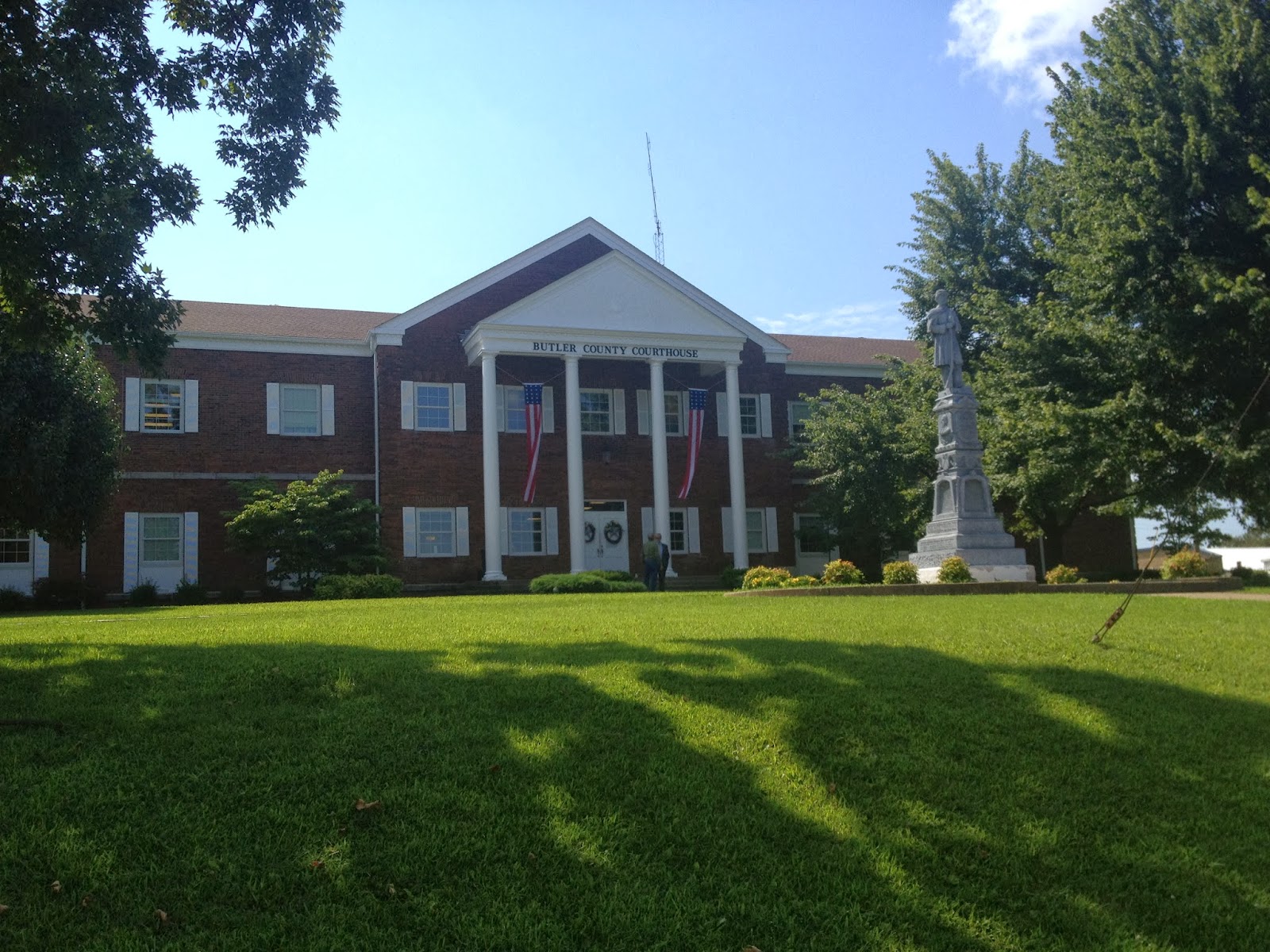
Butler County Courthouse – Morgantown, Ky.
I rolled into Morgantown on an oppressively hot summer afternoon. The courthouse square was almost completely empty when I parked my car and did my usual walk around. 
Morgantown is another one of those communities for which you have to have a reason to go. It’s not along any major interstate or four-lane highway. Butler County only makes itself known to the casual visitor to Kentucky through the brief stretch of the Western Kentucky Parkway that just barely nicks the corner of the county.

Carpenter’s Kentucky Courthouses entry on this courthouse raises more questions than it answers. This present courthouse is the third such building on this cite, but appears to have undergone some considerable renovation since Mr. Carpenter profiled it in his book.  The original building was dedicated in 1975, but this building used to have a cupola, complete with a clock, and the wings on the side were just a single story. Somewhere along the line, the second story was added and the cupola was replaced. Anyone out there know the story? [ed. note: According to the Doyan Courthouse Survey, the Butler County courthouse was extensively renovated in 1998.]

Regardless, the building pictured above, or some iteration of it, replaced a beautiful Italianate two story courthouse that was demolished in 1974. [ed. note: that Italianate, second courthouse served from 1873 until its demolition.]

Morgantown may have originally been known as Funkhouser Hill, after founder Christopher Funkhouser, who donated the land for a proposed county seat. It is unknown for whom the town is named. Possible theories include a hunter named Morgan, or the first child born there (Daniel Morgan Smith who was born December 14, 1811).

To give you an idea of what early 20th century life was like in Morgantown, the first hard-surface roads in Morgantown weren’t built until the 20’s. As a river town, this modern innovation wasn’t felt necessary until 1917 when the Green River froze and the town was left without contact from the outside world for two months.

A sign on the courthouse lawn tells the interesting story of Butler County native William Taylor,  a Republican who was declared winner of the 1899 governor’s race in Kentucky over William Goebel. The Democrats contested the election, and the bitterness over this election led to Goebel being shot, declared governor, and upon his death Goebel’s successor being named governor. For 160 days, Taylor served as governor, two-thirds of that time unofficially, with Kentucky being split between two functioning state governments. After courts decided against Taylor, he moved to Indiana and practiced law and became president of an insurance company.

Am I the only one who finds that story really, really sad?

Camp Nelson is an American Treasure

On March 3, 1865, Congress emancipated all the wives and children of the United States Colored Troops who had not been previously emancipated from the bondage of slavery. This occurred following a public outcry when 102 family members of American soldiers died after being expelled from Camp Nelson in Jessamine County, Kentucky.

Slaves had sought refuge at Camp Nelson where men joined the Union army and their families found temporary refuge. Nearly 24,000 African-Americans enlisted at Camp Nelson to join the army and, if they survived, attain their freedom. Federal policy only allowed free blacks or those with their owners’ permission to enlist. That is, until the policy changed at Camp Nelson.

These two stories are significant to our national historic fabric. They contribute to what makes our nation the land of the free and the home of the brave. And they were the focus, along with historic archeology, of the listing of Camp Nelson as a National Historic Landmark.

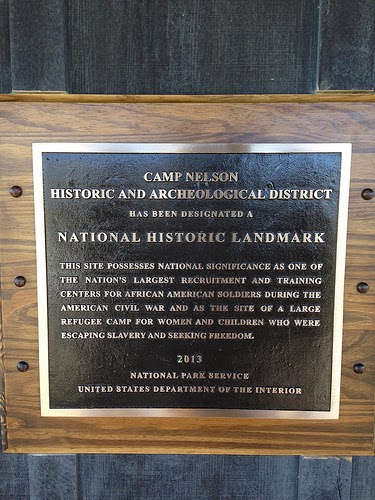
Dr. Stephen McBride, the Director of Interpretation and Archeology at Camp Nelson, told these two stories to those assembled on Saturday for the Celebration of History and Archaeology at Camp Nelson. The main event was the unveiling of the plaque identifying the Camp Nelson Historic and Archeological District as possessing “national significance as one of the nation’s largest recruitment and training centers for African-American soldiers during the American Civil War and as the site of a large refugee camp for women and children who were escaping slavery and seeking freedom.”

The designation as a National Historic Landmark is hugely significant.

Nationwide, there are only about 2,500 NHLs representing fewer than 3% of properties included in the National Register of Historic Place. (A National Register listing is a sign of a significant historic resource and is, of itself, not easily attainable).

Kentucky is a leader in designating its historic sites for inclusion on the National Register. Only New York, Massachusetts, and Ohio have more listings. Of the 3,300 Kentucky sites included on the National Register, only 32 are designated as National Historic Landmarks.

Jessamine County has 72 sites included on the National Register, but Camp Nelson is our only National Historic Landmark.

In other words, this is a big deal! And that’s because each of those two stories at the beginning of this column was a big deal.

Most news articles about the plaque unveiling won’t tell more of those stories than the plaque itself reveals. Instead, news accounts will discuss the politicians who were in attendance and the words that were said on Saturday.

But the significance of this site and of this designation were best told by an unnamed sergeant in the U.S. Colored Troops: “It used to be five hundred miles to get to Canada from Lexington, but now it is only eighteen miles! Camp Nelson is now our Canada.”

In September of last year, I wrote about the historic acreage in southern Jessamine County that was commandeered by the Union troops during the Civil War. The headline read that “Camp Nelson is a Jessamine County treasure.”

That was an understatement. Camp Nelson is a National Historic Landmark. It is an American treasure.

This column originally appeared in the Jessamine Journal
It should not be republished without permission.

Lincoln’s Gettysburg Address was Delivered Seven Score and Ten Years Ago

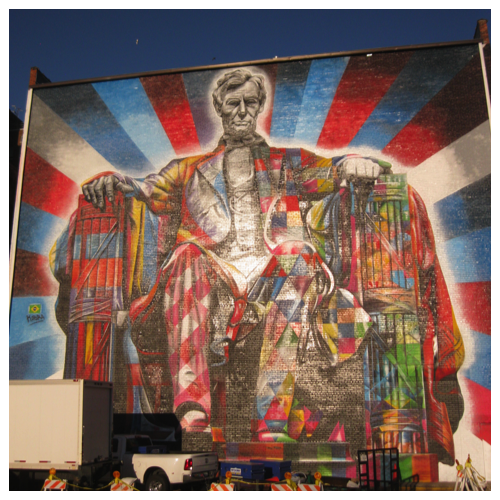
Mural of Abraham Lincoln in downtown Lexington, Ky.

One hundred fifty years ago today, Kentucky native and sixteenth President Abraham Lincoln delivered the Gettysburg Address at the dedication of the national cemetery near the site of the battle which changed the course of the Civil War.

Last week, a mural in downtown Lexington was painted by Brazilian artist Eduardo Kobra. It is a spectacular, modern look at the well known form of the seated Lincoln just as he is immortalized at his Memorial in Washington, D.C.

The words of Lincoln, now 150 years a part of our nation’s history:

Four score and seven years ago our fathers brought forth on this continent, a new nation, conceived in Liberty, and dedicated to the proposition that all men are created equal.

Now we are engaged in a great civil war, testing whether that nation, or any nation so conceived and so dedicated, can long endure. We are met on a great battle-field of that war. We have come to dedicate a portion of that field, as a final resting place for those who here gave their lives that that nation might live. It is altogether fitting and proper that we should do this.

But, in a larger sense, we can not dedicate — we can not consecrate — we can not hallow — this ground. The brave men, living and dead, who struggled here, have consecrated it, far above our poor power to add or detract. The world will little note, nor long remember what we say here, but it can never forget what they did here. It is for us the living, rather, to be dedicated here to the unfinished work which they who fought here have thus far so nobly advanced. It is rather for us to be here dedicated to the great task remaining before us — that from these honored dead we take increased devotion to that cause for which they gave the last full measure of devotion — that we here highly resolve that these dead shall not have died in vain — that this nation, under God, shall have a new birth of freedom — and that government of the people, by the people, for the people, shall not perish from the earth.

Raise Mine Ebenezer.

Ebenezer Church – 

The Bible tells us that “Samuel took a stone and set it up between Mizpah and Jeshanah. He named it Ebenezer, explaining, ‘The Lord helped us to this very point.’” (1 Samuel 7:12, CEB).

The Israelites took the moment to turn again from disobedience finding restoration in God.

Robert Robinson penned the words of the traditional hymn “Come Thy Fount of Every Blessing” in 1758. It, too, referenced Ebenezer:

Here I raise mine Ebenezer
hither by thy help I’m come;
and I hope, by thy good pleasure,
safely to arrive at home.

In A Christmas Carol, Charles Dickens told the tale of Ebenezer Scrooge. The 1843 novel found the miserly Ebenezer begging for the opportunity to re-embrace life.

Whether from the Old Testament, the hymnist, or Dickens, the word Ebenezer conjures up a recognition of our need to be restored so that we can fully embrace life.

There is another reference to Ebenezer even closer to home in rural Jessamine County. A log meeting house constructed in the mid-1790s and there met a congregation identified as the Ebenezer Associate Reformed Presbyterian Church.

The founding minister was Adam Rankin who was a circuit-riding minister based in Lexington. Some believe his home, which was relocated to Lexington’s Mill Street several decades ago but remains standing, is the oldest in Lexington. It was Rankin who began many of the Presbyterian congregations in central Kentucky. Among them are Pisgah and Glenn’s Creek in Woodford County and Mount Zion (now First Presbyterian) in Fayette County.

The long lens of history has found Rankin to have been a disagreeable fellow. In 1789, he rode by horseback from Kentucky to a denominational convention in Philadelphia. There, he fought against the use of modern, contemporary hymns in worship. For Rankin, the worst offense was Isaac Watts’ enthusiastic “Joy to the World.”

Ultimately, Rankin would be permanently suspended from the ministry. He experienced his own restoration, however, as the first president of Miami University in Ohio.
Before then Rankin served as Ebenezer’s minister until 1803 whereafter he was replaced by Rev. Robert Bishop.

In the same year, the old log meeting house was replaced by a stone church which stands today as the oldest such structure in Jessamine County.

The ensuing decades took its toll on the congregation and the building was abandoned in 1883. Once abandoned, the toll was taken on the structure as the roof collapsed and several of the walls had fallen.

But the story doesn’t end there. For there is restoration for this Ebenezer, too.

In 1953, an organization was formed to care for the cemetery, a few thousand dollars was spent by the Ebenezer Cemetery Association to install a new roof, new windows, shutters and restore “the design of the old building as closely as possible.”

The old structure remains cared for a half century later. According to the 1983 application to the National Register of Historic Places, the Ebenezer Church is the only remaining stone church in Jessamine County and the oldest religious structure in the county dating from the settlement period.

The prophet Samuel took a stone and set it up and named it Ebenezer. Here, in Jessamine County, our own Ebenezer still stands thanks to those who gave it the opportunity to do so.

It is a tranquil, country church surrounded by the headstones of those who once worshipped here.

Though Ebenezer’s doors remain closed most of the year, one can easily find restorative peace in this place. There are many such places in our county. But as for Ebenezer — there’s just something about that name.

This column originally appeared in the Jessamine Journal
It should not be republished without permission.
On #VeteransDay, Remembering the Doughboy Statue

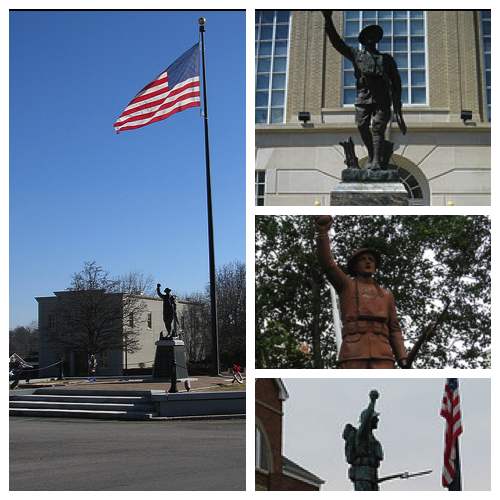
Viquesney Doughboy Statues in Jamestown, Pikeville, Grayson, and Morehead, Ky.
(Photos: the author, identified circular from the left)

On this Veterans Day, we recall the service of those who served our nation. To those veterans, we say “thank you.” Around the country and around Kentucky, memorials stand to the veteran of the several conflicts. One of the most recognizable memorials is the Viquesney statue of which 140 known copies exist.

When in Meyersdale, Pa. in April of this year while cycling on the Great Allegheny Passage, I immediately recognized the outstretched arm of the Viquesney’s “The Spirit of the American Doughboy.”

First designed and sculpted by E.M. Viquesney in 1920, “The Spirit of the American Doughboy” went through a few design changes over the years. Though most don’t realize it, Viquesney’s doughboy is likely the most witnessed sculpture in the United States other than the Statue of Liberty herself.

In Kentucky, eight Viquesney statues are known to exist in the following towns: Grayson, Harlan, Jamestown, Liberty, Monticello, Morehead, Pikeville and Winchester. The first of these to be installed was the Monticello doughboy in January 1923; the last was in Jamestown 75 years ago today on Armistice Day, 1936.

Beyond being noted as Veterans Day in the U.S., November 11 has a symbolic meaning in our country and around the globe for on “the eleventh hour of the eleventh day of the eleventh month” in the year 1918, hostilities with Germany ended thus concluding “The Great War” (n/k/a World War I). In America, this date was celebrated for years as Armistice Day until after the conclusion of another great war – World War II – that the date became known simply as Veteran’s Day. In other countries, November 11 is referred to as Remembrance Day.

I am particularly fond of the original term Armistice Day because of its historic context. The young Americans in the early part of the twentieth century crossed the ocean to fight the Germans in an era when crossing the ocean wasn’t something you did for reasons other than immigration.

Whatever its name, it is a day to thank the men and women in uniform who have served our country. And though many people only recognize today as being a day when schools, banks and government offices are closed, it is because our soldiers fought that we can enjoy our freedoms today.

This Just Happened, a weekly roundup

Fall Colors at Mount Hope, Gratz Park, Lexington, Ky.

From this week on The Kaintuckeean:

And from elsewhere around the Commonwealth, after the jump:
The Lexington Farmer’s Market will remain open, outdoors, all winter. [BizLex]
Talk of new city hall in Lexington raises some questions and retrospective thinking [Streetsweeper]
Shorty’s, Lexington’s downtown grocery, set to reopen under new ownership [BizLex]
Interesting and thought-provoking question à la Jeff Foxworthy: you might be a preservationist if? [Bricks+Mortar]
NKU is offering a historic preservation class. Wish I had taken something like that instead of all those accounting classes… [KyForward]

Kentucky a leader among States

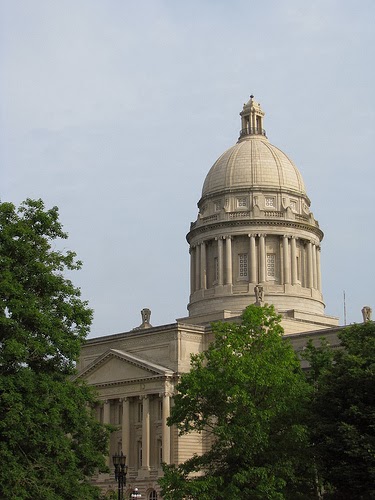
Kentucky State Capitol – Frankfort, Ky.

Though I’m not a native, I love Kentucky.

Her terrain, her people, and her culture make her one of the Union’s most spectacular states. Unfortunately, we have historically ranked near the bottom in other important metrics such as health, economics, and education.

So when Kentucky is heralded as a model for something done right, we should accept the compliment with gratitude and take pride in a job well done.

Politics aside, we should be taking pride in the fact that Kentucky is being heralded by politician and prognosticator alike for kynect.ky.gov.

That is Kentucky’s healthcare exchange website created under the Affordable Care Act (aka, Obamacare).

Among those breathing the words “Kentucky” and “success” (without the word “basketball”) in the same sentence have included those at the Wall Street Journal and National Public Radio.

Rep. John Yarmuth of Louisville indicated President Obama’s pride in the Commonwealth, “The president said … the place that has done best is Kentucky.”

So while Washington’s healthcare.gov was haphazardly unveiled with only limited testing, Kentucky’s website was smartly created with sigificant testing along with utilizing a simpler website design less likely to cause headaches.

It worked. A simple website design was needed because many Kentuckians do not have high-speed Internet, a problem that plagues many rural parts of the country. Kentucky considered this fact, though it seems that the federal website ignored this factor.

Of course, many can’t seem to put politics aside and just be proud of the Commonwealth’s achievement.

The Republicans — five Congressmen and two Senators — sent by Kentuckians to Washington have derided Obamacare at every opportunity along with the federal government’s healthcare.gov.

They have, however, been largely silent on Kentucky’s own success story.

I understand the politics at play, but I cannot accept partisanship over pride when it comes to the Commonwealth.

I’d suggest Sens. McConnell and Paul and Reps. Barr, Guthrie, Massie, Rogers, and Whitfield each issue a statement along these lines: “Though personally opposed to Obamacare, I commend the ingenuity and hard work involved in creating Kentucky’s website. The country should look to states like Kentucky for leadership, not Washington.”

That would be a strong message of democracy in action, of federalism, and of conservative values while still expressing a “job well done” mentality. It’s the kind of statesmanship that is missing in Washington.

Instead of taking that approach, Sen. Paul prophesied the failure of Obamacare over the weekend because it was a government-created solution.

“I think government is inherently inept, because they don’t work on a profit motive,” Paul said.

While Sen. Paul may believe government to be inherently inept, it is disturbing to follow his logic.

Consider the following which don’t operate “on a profit motive”: churches, charities, aid relief organizations, non-profits.

While specific organizations may have flaws, the non-profit motive does not make an organization “inherently inept.”

Sen. Paul, an ophthalmologist, is known to provide pro bono eye surgeries to Kentuckians during Congressional recesses. And he should be commended for giving back to needy Kentuckians.

But using the Senator’s own logic, would he suggest that his performance during a pro bono surgery is inept simply because it is being provided without a profit motive?

Of course, he wouldn’t. I’m sure that Dr. Paul takes great care in each surgery he performs. I’m sure he always does his very best.

Yet so do churches, charities, aid relief organizations, non-profits. And yes, even governments.

So take heed of these Kentucky lessons. To do your best, to accept a compliment with gratitude, and to take pride in a job well done.

This column originally appeared in the Jessamine Journal
It should not be republished without permission.