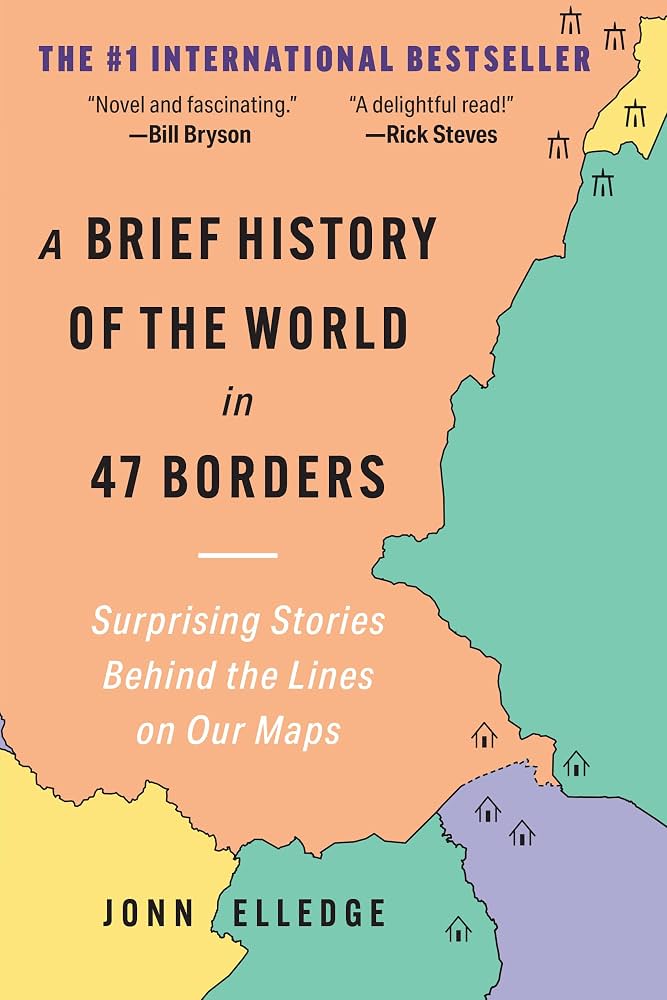
I’ve always found geography to be an interesting subject, so when I was in a book store in Washington DC a few months ago a book caught my eye: A Brief History of the World in 47 Borders, Surprising Stories Behind the Lines on Our Maps by Jonn Elledge.
Perusing the table of contents, I found a good number (well, 47) of shortish chapters perfect for the subject matter — though Elledge provides good depth and curious anecdotes on each of the mini subject-matters covered. For example, a chapter entitled “Why is Europe not a peninsula of Asia” asks a valid question.
The Ural Mountains and the Caspian Sea, while certainly important topographical features, are not elsewhere used to separate continents. The Himalayas might separate the Indian subcontinent from the remainder of Asia, but isn’t that what the author asks of Europe? That Europe is a dependency of Asia.
Of course, Europe is Europe and mighty because Europe is the land of Charlemagne. Of Rome. The cradle of Western Civilization. And of Empire. The empires and the related colonialization which led to so many of the lines on the map …
For purposes of this blog, one particular chapter stood out: The Dangers of Gardening in the Korean DMZ. The border of the two Koreas once ran along the thirty-eighth parallel north, though the DMZ now only approximates this line (there’s a whole chapter on longitudinal lines and latitudes). What stuck out was this:
The name of this line – which at other points on its journey around the globe visits such places as Lexington, Kentucky and Murcia, Spain – is still associated with the border between the two zones of the peninsula.
That’s right, I found Lexington right in this wonderful book!
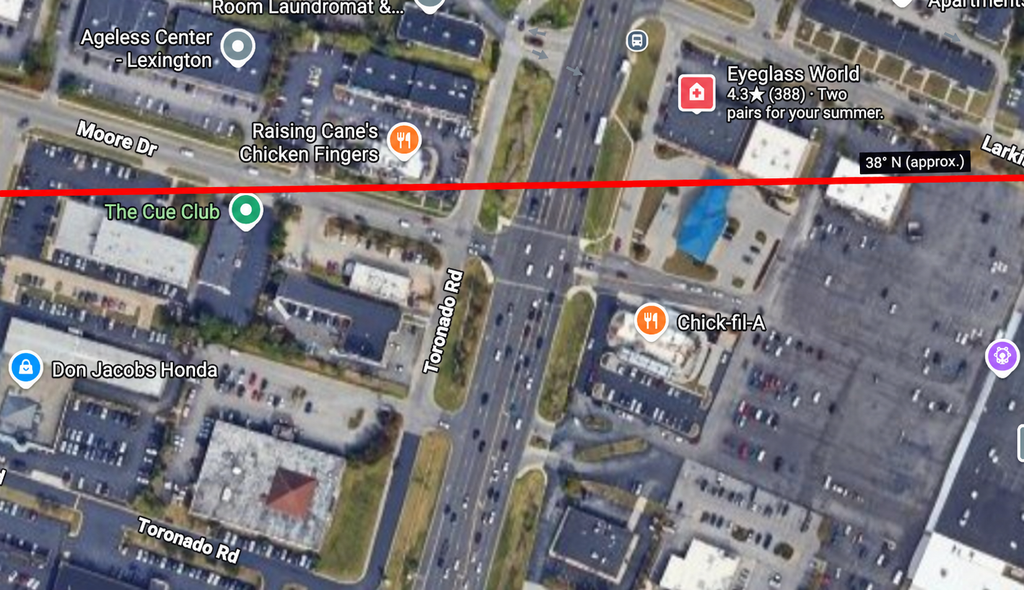
As you can see from the map above, the Thirty-Eighth Parallel crosses Lexington’s Nicholasville Road somewhere between Raisin’ Cane’s and Chick-Fil-A. If you’re on Harrodsburg Road, the point of marcation is the entrance to the Palomar subdivision, but I thought putting two fast food chicken places on either side of the demilitarization zone a better exercise.
And speaking of the sprawl on Nicholasville Road, another chapter addresses City Limits through the context of Detroit.
The book is a most enjoyable read. You’ll certainly learn something from it, including why Israeli musicians are able to compete in the Eurovision contest.